Last time, we explored the wide range of advertising opportunities offered by Google, the world’s most popular search engine. This time, we’ll take a closer look at one of the most effective Google Ads solutions: search advertising. Why is it so powerful, and how can you use it to reach potential customers? We’ll answer these questions and more in today’s blog post.
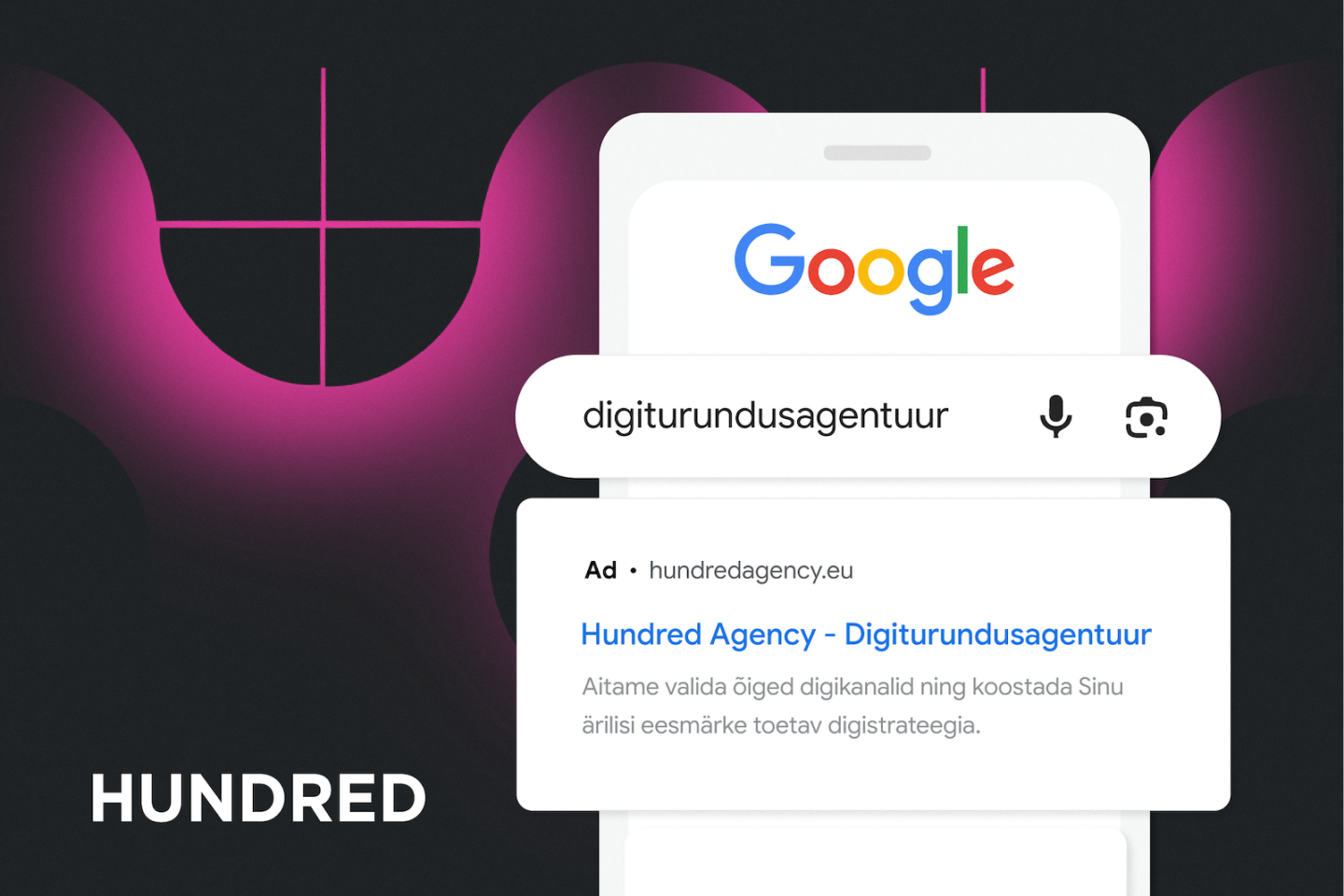
Otsingureklaam kui esimene samm GSearch Advertising: The First Step in Google Marketing
If you’re planning to start advertising with Google Ads, we recommend focusing on search advertising—Google Search Ads—as your first step. Why? Because search ads help you reach potential customers at the exact moment they are looking for your product or service and are often ready to make a purchase decision.
The key advantage of search advertising lies in user intent. When someone types a query into Google, such as “fence installation in Tallinn”, “laboratory microscope”, or “website development services”, they are already actively searching for a solution. Unlike social media advertising, which interrupts users while they are browsing content, search ads appear when people are focused on finding information, comparing options, or making a purchase.
This is why search advertising is often regarded as one of the most effective digital marketing channels in terms of return on investment. For example, the average return on ad spend (ROAS) for e-commerce businesses using search advertising is around 400%. In other words, every euro invested in search ads generates an average of four euros in revenue.
Which Campaign Type Should You Choose?
For websites with a simpler structure, a standard Search Campaign is usually the best choice. In this case, you select the keywords you want your ads to appear for and build a logical campaign and ad group structure around them.
For example, a local dental clinic might advertise on Google using keywords such as “dentist in Tartu” or “teeth whitening.” At the same time, an online store could target searches like “robot lawn mower” or “home office chair.”
For larger websites and e-commerce stores, it is worth considering Dynamic Search Ads (DSA) as an additional solution. With this campaign type, Google analyzes the content of your website to identify relevant search queries and automatically generates ads based on that content. As a result, your ads can cover a much larger portion of your website and reach potential customers through searches that you may not have considered when planning your keyword strategy.
In practice, the best results are often achieved by combining these two approaches. Traditional search campaigns cover your most important keywords, while Dynamic Search Ads help capture additional traffic opportunities across the rest of your website.
The Key to Success Lies in Well-Considered Campaign Structures
One of the most common mistakes in Google Ads is using a campaign structure that is either too simplistic or, conversely, overly complex. A well-structured account makes it much easier to understand which keywords, ads, and target audiences are delivering results.
Let’s take the example of an auto repair shop that offers a range of services. If you create a single, general campaign called “Auto Repair” that combines all keywords and uses one generic ad, it will not help users find relevant solutions—it will likely only create confusion. Someone searching for a tire change may see an ad focused on engine repair and simply skip it.
Instead, it is far more effective to create several ad groups, each with a specific focus, tailored keywords, ad copy, and dedicated landing pages.
- Tire Change
- Keywords: tire change in Tallinn, tire installation, affordable tire change
- Ad copy: “Quick tire change in Tallinn. Book an appointment online in 5 minutes!”
- Brake Repair
- Keywords: brake pad replacement, brake inspection, squeaky brakes
- Ad copy: “Your safety comes first. Professional brake repair and inspection.”
- Air Conditioning Recharge
- Keywords: air conditioning recharge, car air conditioning recharge, air conditioning repair
- Ad copy: “Car air conditioning recharge and inspection. Enjoy a comfortable ride!”
With this structure, you can create more precise and relevant ads. In addition, campaign optimization becomes significantly easier, as performance data is clearer and more actionable.
The more products or services you offer, and the larger your Google Ads account becomes, the more important a well-thought-out structure becomes. It enables you to make more informed decisions when building campaigns and achieve better results with the same budget.
In addition, Google rewards well-structured campaigns—with clearly defined ad groups and relevant keywords—by assigning a higher Ad Rank and often charging a lower cost per click for the traffic they generate.
Don’t Forget Ad Extensions
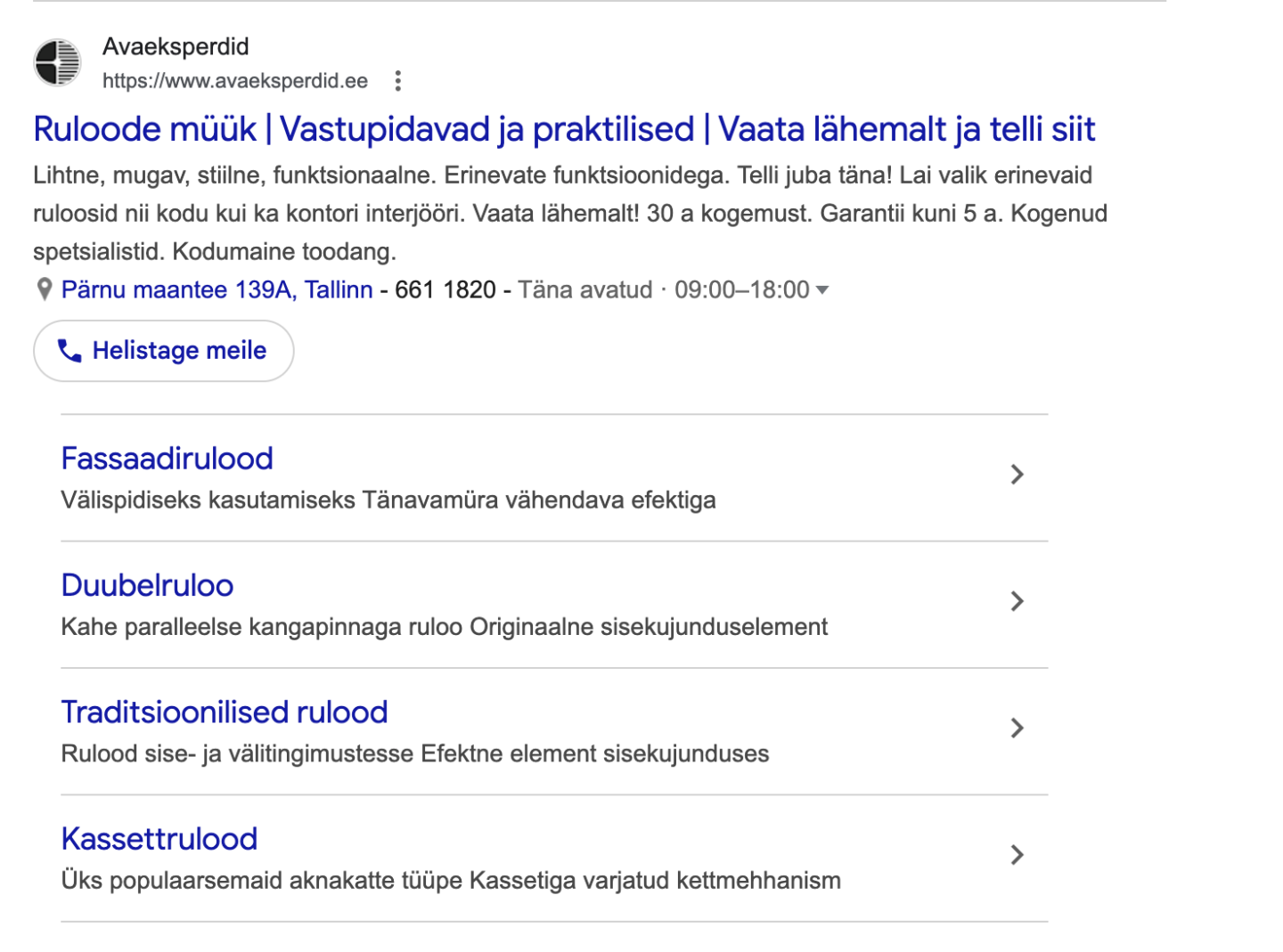
In addition to ad copy, you can also add extensions (now called assets) to your Google Ads. These are additional pieces of information that appear beneath your main search ad, making it larger, more prominent, and more informative—and therefore giving users more reasons to click your ad.
Adding extensions is free—you only pay when someone clicks on your ad or on the extension itself.
Example: Extensions appear below the main ad text and take up a significant amount of space, which can even push competing advertisers out of view on smaller screens.
To get started, you could use the following extensions:
- Business Name – your company name
- Business Logo – your company logo
- Sitelinks – such as “Fassaadirulood” in the example above, which lead to specific pages and make it easier for customers to reach a service directly
- Callouts – short phrases highlighting your company’s advantages, such as “2-year warranty” or “Free parking”
- Call Extension – adds a phone number directly to the ad, allowing users on mobile devices to call you immediately
- Image Extension – a small square image of your product or service that helps attract attention in text-based search results
- Location Extension – shows your business address and opening hours
Google dynamically decides which extensions to show for each search and in which combination. Therefore, we recommend adding as many relevant extensions to your account as possible.
The Right Bidding Strategy Affects Results
In addition to keyword selection, ad groups, and extensions, it is also important to use a suitable bidding strategy. For example, if you are a newly launched brand entering the market, increasing visibility may be the first priority. In that case, focusing on impressions can be a good starting point. Over time, website traffic, the number of inquiries, and revenue growth typically become more important. At that stage, you can transition to click-based or conversion-based strategies.
Therefore, search advertising should always be aligned with clear goals, and the bidding strategy should be chosen according to the desired outcome.
Summary
When starting with Google Ads, the most logical first step is usually search advertising, which allows you to reach users who are actively searching for your product or service. For simpler websites, a standard search campaign is typically sufficient. For larger websites, it may be beneficial to use dynamic search ads or a combination of both.
A well-structured search campaign not only drives more traffic but also helps increase sales, inquiries, and overall visibility compared to competitors. That is why it remains one of the most effective digital marketing tools and a strong starting point for your Google Ads journey.
If you need support with campaign structure, copy texts, choosing extensions, or setting up your ads, feel free to contact our experienced marketing team: